
How to actually learn from YouTube
A 7-step guide to using YouTube like a researcher, not a passive viewer

I’ve spoken before about how brilliant YouTube is as an educational resource, but using it as a learning tool rather than a distraction requires a strategy.
Without one, it’s all too easy to convince yourself you’re learning because you’re watching “educational” content, when in reality you’re just using it like any other social media app (as a time-sucker).
In other words, there’s a big difference between watching YouTube and engaging with it.
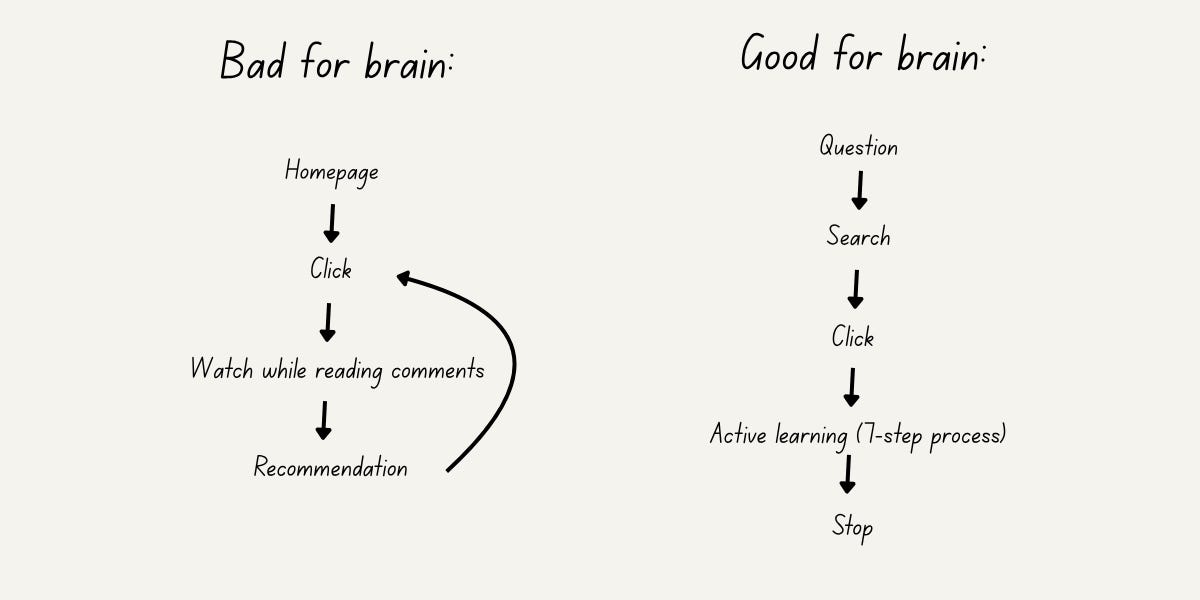
Now, I’m not saying there’s anything wrong with watching YouTube purely for entertainment. But if you want to actually learn from a video, you need a way of approaching it like a student rather than a passive viewer, which is exactly what this 7-step process will help you do.
The 7-Step Strategy for Learning from YouTube
Step 1: Predict, then press play
When you find an interesting video, it’s pretty much second nature to hit play immediately. Resist the urge. Spend at least 30 seconds properly reading the title, description, and chapters, and ask yourself (where applicable):
What do I already know about this subject?
What do I expect to learn?
What do I think the main argument will be?
You don’t actually need to know anything about the subject to do this; even a guess is useful. The prediction itself helps you to understand and remember the content better, and primes your brain to find answers to questions rather than passively absorb facts.
Step 2: Pause and retrieve
Once you’ve started watching, pause the video every few minutes (or at the end of a major section/chapter) and try to recall the main points.
You can do this in your head or write them down. Again, it doesn’t matter if you get it slightly wrong — the act of trying to remember is what strengthens the memory. Research shows that retrieval practice helps you remember information and learn it in a way that’s flexible and usable later, meaning you can recall it in your own words and actually apply it outside the video itself.
Step 3: Take notes *intentionally*
Taking notes can be super useful when you’re selective about it. Avoid trying to write everything down (that’s just a transcript), and instead only note down the main points in your own words. Granted, trying to figure out what’s actually important is easier said than done, but this can be a useful guide:
Repetition: If the creator keeps coming back to an idea, reframing it, or using it to introduce the next part, write it down.
Movement: If the idea pushes the explanation forward (answers the core question, develops the argument, or sets up the next concept), write it down.
Impact: If the point makes something click or brings a concept together, write it down.
Step 4: Acknowledge the confusing parts
When you’re actually engaging with a YouTube video, you’ll likely have questions. This is a good thing — it means your brain is working.
Maybe the creator skims past a concept you’re unsure about or uses a term you’ve never heard before, or you begin to wonder how the argument relates to another topic.
The moment a thought pops into your head, jot it down (this is useful for learning in itself but will also guide you on what to research next).
Step 5: Explain it in your own words
When the video’s finished, look away from your notes and have a go at explaining the concept in your own words. There are several ways you can do this:
In your head
Out loud to a willing (and patient) friend or family member
Writing it down
Forcing yourself to explain it without having something to refer back to makes you actively work out the relationships between ideas and exposes gaps in your understanding. This is essential for understanding rather than just consuming.
Step 6: Have a break
Autoplay and recommendations with click-bait titles can make it far too easy to keep watching without giving yourself the chance to absorb anything.
Once you’ve finished a video, step away from the screen rather than immediately clicking onto another one. Spreading your learning out over time, rather than cramming it into one continuous session, tends to produce better long-term retention.
Step 7: Find the questions to your answers
Once you’ve been on a walk, had a cup of tea, or stared into space for a while, go back to the questions you wrote down and start looking for answers. You can look for more videos on YouTube, but I personally like to read articles to give my brain a break from visual learning (but it’s whatever works best for you).
As you look for answers, don’t treat the new source as completely separate from the original video. Keep thinking back to what you watched originally and ask:
Does this explain the part I was confused about?
Does it support what the creator said or contradict it?
Does it give me a different perspective?
How does this argument differ from what I learnt before?
This approach can help solidify any facts, train your brain to connect ideas, and is a great opportunity to get critical. Does anything contradict what the previous video said? Does it frame the idea differently? Does it rely on stronger or weaker evidence? Training your brain to question, compare and evaluate the information you consume is just as important as remembering it.
Once you’ve completed the 7 steps, I highly recommend stopping for an extended period of time. The whole point of this process is to consume with intention, not just consume, consume, consume. Learning works best when you give your brain time to process things.
Thank you for this, as I have fallen into the consume, consume, consume cycle with full intent to learn but resulting in little learning on the backside.